
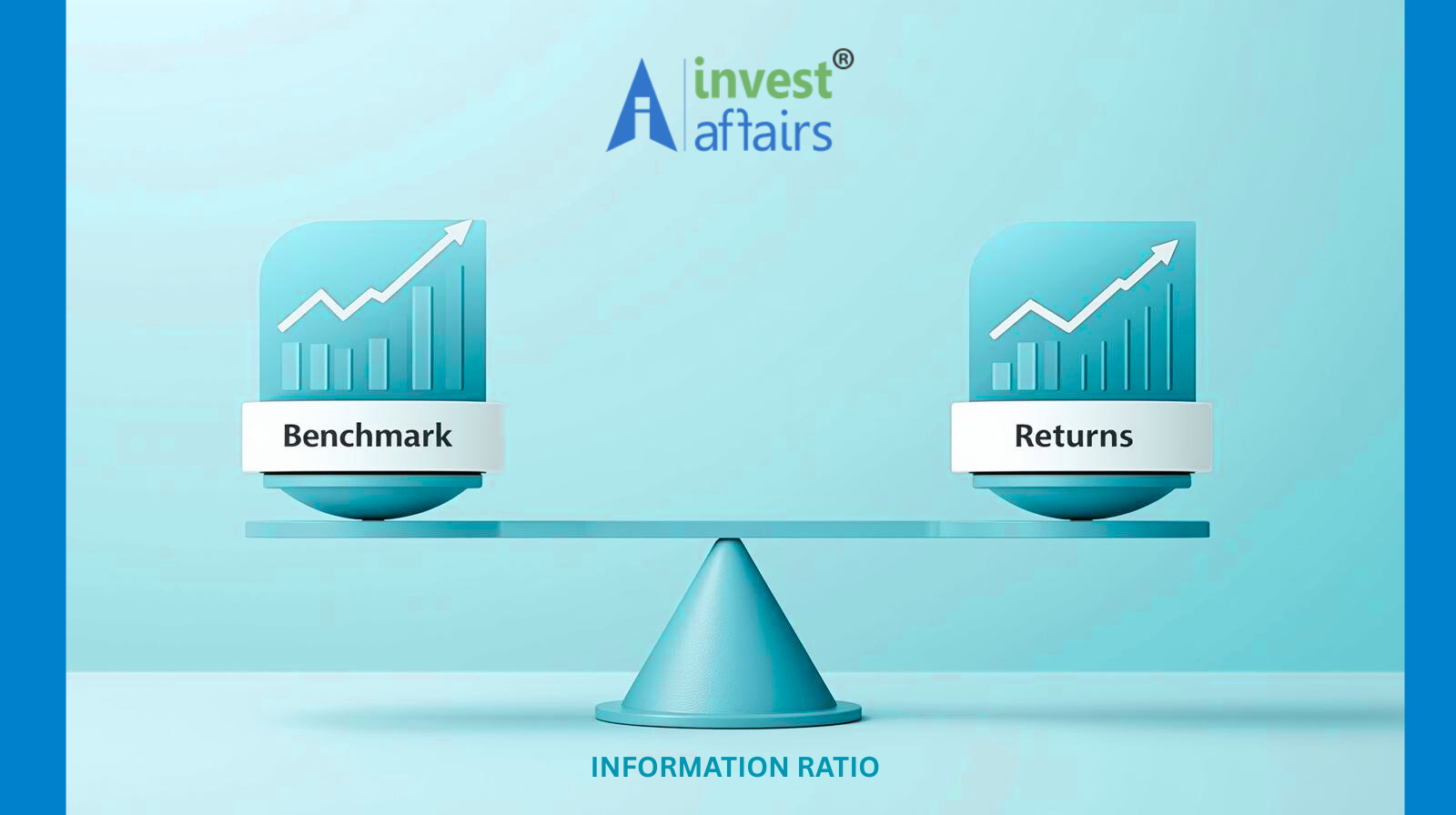
CHARTING YOUR COURSE : HOW THE INFORMATION RATIO ENHANCES MUTUAL FUND SELECTION
- Fri Aug 29 18:30:00 UTC 2025
- In mentoring and guidance by Aparna Bose
Mutual funds are often praised as a reliable option for diversifying portfolios and achieving long-term financial growth. But, like any investment, they carry risks. A key metric to evaluate whether a mutual fund justifies its risk is the Information Ratio (IR).
It influences almost every decision investors make, helping them cut through the noise of complex market movements. Given the inherent complexity of these markets a wide range of metrics has evolved to capture different aspects of performance and risks. Among them the IR (Information Ratio) stands out as a particularly valuable measure- used extensively by both investors and market professionals to evaluate performance with great precision.
In a significant move to bolster transparency and aid informed decision-making among investors, the Securities and Exchange Board of India (SEBI) has directed mutual funds to disclose the information ratio of their scheme portfolios. This new mandate is designed to provide a clearer picture of a fund’s performance, considering both returns and the associated risks.
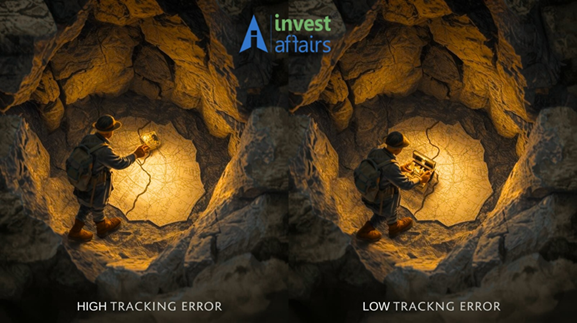
So, think of the tracking error as the footprint you leave in the jungle. A low tracking error means you’re consistently outsmarting the map, finding more treasure over time. But a high tracking error? That’s when your journey becomes more volatile, and you don’t consistently exceed the map’s predictions.
In the same manner, the Information Ratio is your guide in this financial jungle, helping you understand not just how much treasure you’ve found, but how you’ve found it. Remember, every explorer has their own path. Therefore, your journey is unique, and so is your Information Ratio.
WHY THE INFORMATION RATIO (IR) IS IMPORTANT?
- Consistency in Performance : A high Information Ratio indicates that the fund manager consistently outperforms the benchmark, which is key for building long-term wealth.
- Risk Management : It shows how well the fund manager manages risks while aiming to outperform the benchmark.
- Decision-Making Tool : Investors can use the Information Ratio to compare different mutual funds, helping them select the one that delivers superior risk-adjusted returns.
- Evaluation of Manager Skill : The Information Ratio helps assess a manager’s ability to generate returns consistently, not just during favourable market conditions, giving investors’ confidence in the manager’s skill.
- Understanding Volatility : By factoring in tracking error, the Information Ratio helps investors understand the level of volatility in a fund’s performance, offering a clearer picture of the potential risks involved.
WHY ONE SHOULD NOT IGNORE THE INFORMATION RATIO
Investors who overlook the Information Ratio may choose funds that appear attractive based on past performance but lack consistency or involve too much risk. For instance :
a)A fund with a low IR may have shown high returns in the past due to risky investments, but such returns might not be reliable going forward.
b) Neglecting this metric could lead to an imbalanced portfolio, increasing exposure to unnecessary volatility.
LIMITATIONS OF INFORMATION RATIO
Although the Information Ratio is a valuable metric, it has certain limitations that users should keep in mind.
- Emphasis on Relative Performance : The Information Ratio only measures performance in relation to a benchmark and does not reflect the fund’s absolute returns. A portfolio could have a high Information Ratio while still generating poor absolute returns if the benchmark itself underperforms.
- Dependence on Benchmark Selection : The effectiveness of the Information Ratio is closely tied to the benchmark chosen. Different benchmarks can yield varying IR values, complicating comparisons. Therefore it is essential to carefully evaluate the relevance of the benchmark being used.
- Ignores Market Conditions : The Information Ratio does not distinguish between performance in bull and bear markets. A fund with a high IR during a market upswing may struggle during downturns.
- Inability to Consider External Influences : The Information Ratio does not account for external factors that could affect a fund manager's performance, such as shifts in market conditions, regulatory changes, or unforeseen events. These elements can significantly impact a manager's ability to achieve alpha.
KEY POINTS TO CONSIDER
While mutual funds are a great investment option, it’s important to understand risk-adjusted metrics like the Information Ratio to make well-informed choices. The wealth managers at Investaffairs always match the mutual fund selections of our esteemed clients with their risk tolerance and financial objectives. Using metrics like the Information Ratio helps take a data-driven approach when choosing funds.
This reliable tool aids in navigation by comparing the additional assets you’ve acquired to the volatility of those assets. Your guide is typically an index that represents the broad environment (market) or a specific area (sector).
The IR is like your loyal sidekick, measuring your skill and ability to unearth more treasures than what the map (benchmark) shows. It’s not just about the amount of treasure, but also the consistency of your performance. That’s where the tracking error comes into play.
CALCULATION AND SIGNIFICANCE
The information ratio is calculated using the following formula:
Information Ratio (IR) = (Portfolio Return – Benchmark Return) / Tracking Error
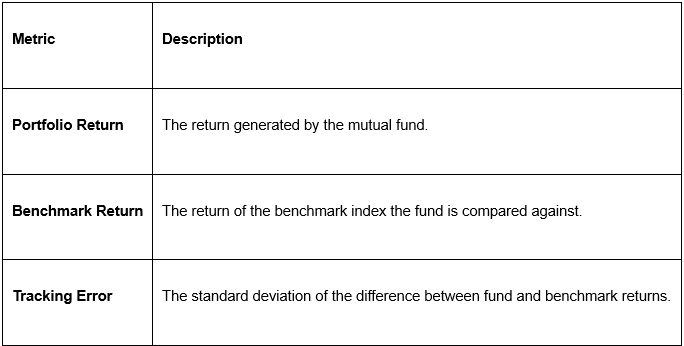
A higher information ratio indicates that the fund has outperformed the benchmark without taking undue risk, while a lower ratio suggests that the fund has taken significant risks without delivering commensurate returns.
While the funds compared may differ in nature, the IR standardises their returns by dividing the difference in their performance, known as the expected active return, by the tracking error.
Investors can calculate tracking error by taking the standard deviation of the difference between portfolio returns and index returns. In addition, a financial calculator or Excel can be used to calculate the standard deviation.
Additionally, the ratio helps fund managers identify areas for improvement in their investment strategies and fine-tune their approach to minimise tracking errors and maximise excess returns. Higher information ratios can also justify higher service fees for fund managers, as they demonstrate their ability to deliver risk-adjusted performance.
KEY POINTS OF THE DIRECTIVE
A COMPARATIVE SNAPSHOT OF HYPOTHETICAL FUND PERFORMANCE:
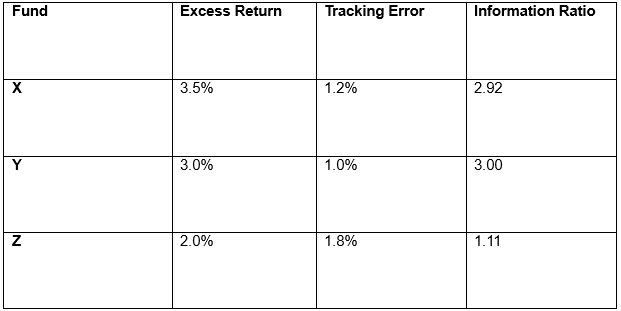
These figures illustrate how one fund may deliver similar returns with much lower volatility—or vice versa—helping investors identify consistency.
Final Thoughts
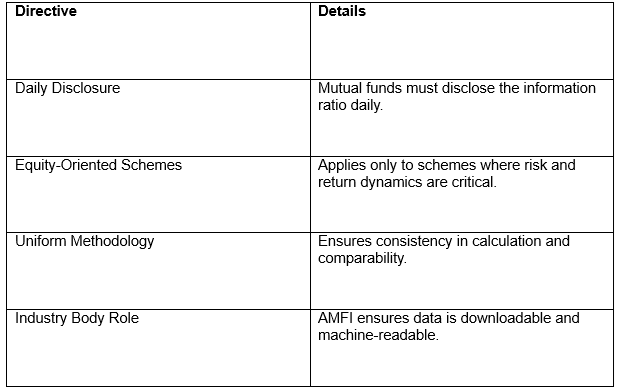
- From April 2025, SEBI mandates that equity mutual funds must display IR figures on their websites across 1 , 3 , 5 , and 10 year periods. AMFI will aggregate and publish these in a machine-readable format to facilitate comparisons.
IR ≥ 1 : Excellent—implies consistent outperformance with controlled risk.
IR ≈ 0.5: Decent, acceptable risk-adjusted performance.
Negative IR: Red flag—high risk taken without corresponding return. - Even small improvements from regular to direct plans can significantly raise IR—make the switch if aligned with your goals.
- Use IR in tandem with other metrics like Sharpe Ratio, Alpha and attribution analysis for a rounded evaluation.
- Focus on funds with stable, high IR across 3, 5, and 10-year windows to gauge performance persistence.
- As IR becomes a standard display metric per SEBI guidelines, leverage the data shared by AMCs and AMFI to compare fund managers effectively.
Disclaimer: The data and information has been sourced from various domains available to the public. We have taken utmost care to represent the same as factually as has been made available. Please do not make any decisions based on our blogpost. Kindly check the data & information independently. For further guidance on finance and investment please reach out to our experts at Investaffairs.
If you have any Personal Finance query, do write to us
Categories
Recent Posts


